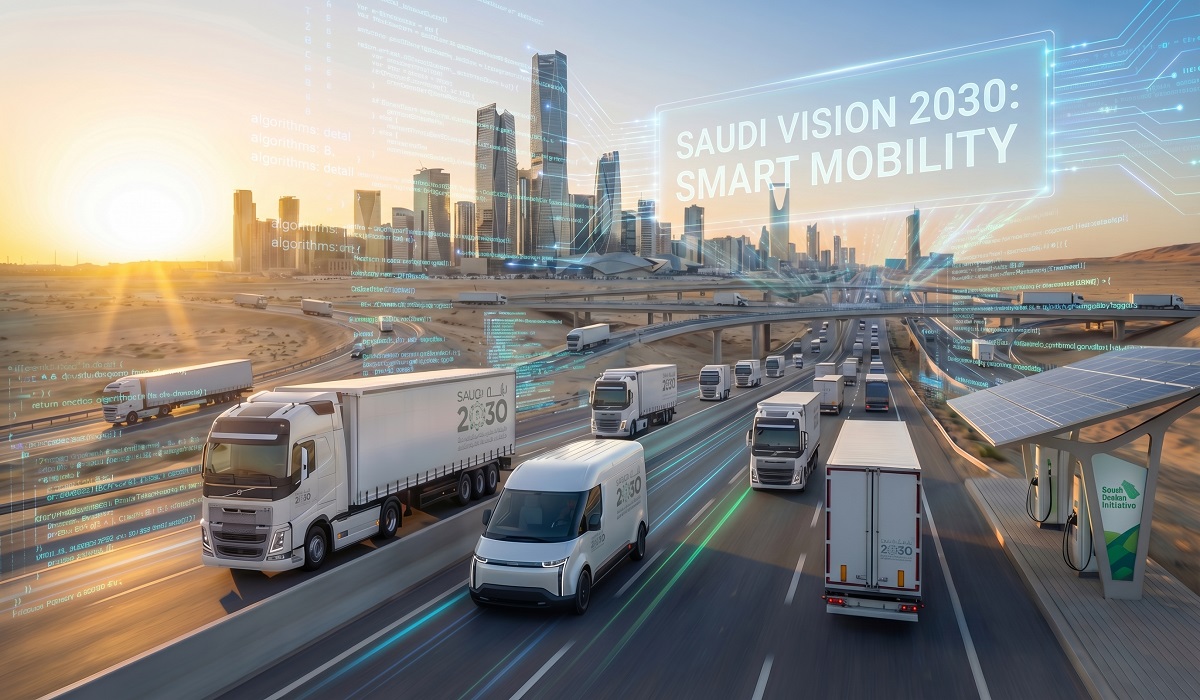
Saudi Arabia is in the middle of one of the most ambitious national reinventions the world has ever seen. And smart transportation sits right at the center of it.
If you run a logistics company, manage a government fleet, or operate any kind of vehicle-dependent business in the Kingdom, the next five years will either work for you or against you, depending on how quickly you start paying attention. Smart transportation Saudi Arabia is not a buzzword or a distant concept. It is actively being built into the infrastructure, regulation, and investment priorities of the country right now.
Here is what that means for businesses and what you can do about it.
Vision 2030 and the Road It’s Paving for Smart Mobility
Saudi Vision 2030 is a national framework built to reduce oil dependence, diversify the economy, and modernize the country’s infrastructure (Vision 2030, n.d., #). Within that broad agenda, mobility sits in a particularly interesting position.
The Vision commits to building smart cities, digitizing public services, and creating a world-class transportation network. NEOM (NEOM, n.d., #), the Qiddiya project (Qiddiya, n.d., #), and the expansion of Riyadh’s metro (Riyadh Metro, n.d., #) are not isolated projects. They are pieces of a deliberate strategy to reimagine how people and goods move across the Kingdom.
For companies, this creates a practical reality: the Saudi government is actively spending on digital transformation fleet KSA, upgrading infrastructure, and opening the market to technology-driven mobility providers. Contracts are being awarded. Tenders are being issued. New standards for how fleets operate are being set by regulatory bodies. Businesses that align with those standards early tend to win more work and face fewer compliance headaches later.
The question is not whether smart mobility is coming. It is already here. The question is whether your company is positioned to benefit from it.
Autonomous Vehicles: Closer Than Most Companies Think
Autonomous vehicles Saudi Arabia is a topic that generates both excitement and skepticism. Many business owners hear “self-driving” and imagine a distant science fiction scenario. The reality is more immediate.
Saudi Arabia signed deals with companies like Lucid Motors (Reuters, n.d., #) and has actively explored autonomous shuttle systems for NEOM. The country’s wide road infrastructure, relatively new urban planning in key zones, and government appetite for first-mover technology make it an unusually hospitable environment for autonomous vehicle pilots.
For fleet managers, this matters for two reasons. First, fleets that have already invested in vehicle tracking and telematics infrastructure are far better positioned to integrate autonomous systems when they become operationally viable. Second, the regulatory frameworks being developed for autonomous vehicles will almost certainly require GPS, route logging, and real-time monitoring capabilities, exactly the kind of infrastructure a Smart GPS system like tracking.me already provides.
Start with visibility. Full automation comes next.
Green Mobility: The Transition That Companies Cannot Ignore
Green mobility Saudi Arabia has accelerated faster than many observers expected. The Kingdom pledged to reach net-zero emissions by 2060 and to generate 50% of its electricity from renewables by 2030 (Saudi Green Initiative, n.d., #). That is not a vague aspiration. It comes with real policy weight behind it.
Saudi Aramco (Aramco, n.d., #), SABIC (SABIC, n.d., #), and NEOM have all made public electric vehicle commitments. Electric buses are being trialed in Riyadh (Arab News, n.d., #). The infrastructure for EV charging is being built across major cities. And government procurement policies are beginning to factor in emissions performance when evaluating fleet contracts.
For a logistics company or a fleet-heavy business, this trajectory has direct cost implications. Diesel-dependent fleets face higher operational risk over the next decade as regulations tighten and fuel subsidies evolve. Companies that begin evaluating hybrid and electric options now, and who are already monitoring fuel consumption and route efficiency through telematics, will have a data advantage when making those transition decisions.
Green mobility is not just about environment. It is about staying commercially viable in a market that is changing its rules.
Fleet Modernization: What It Actually Looks Like in Practice
Fleet modernization Saudi Arabia tends to be discussed in abstract terms. Let’s make it concrete.
A Saudi construction company with 60 vehicles across three regions faces predictable problems. Fuel theft. Unplanned maintenance downtime. Drivers taking unofficial detours. Vehicles sitting idle. Route duplication. These are not edge cases. They are the daily friction that erodes margins.
Fleet modernization means solving those problems with technology rather than just more supervisors. It means installing vehicle tracking Middle East-compatible systems that log every movement, flag anomalies, and generate reports your operations manager can act on the same morning. It means setting geofences around job sites so you know when a vehicle leaves an authorized zone. It means getting automatic alerts when a vehicle is due for service before the breakdown happens.
The return on investment for this kind of modernization tends to be visible within the first quarter. Fuel costs drop because waste is now measurable. Insurance premiums fall because risk is documented. Driver behavior improves because accountability is transparent.
This is not futurism. It is just good operations, enabled by the right technology.
Logistics Optimization in Saudi Arabia: The Real Competitive Edge
Logistics optimization Saudi Arabia has become a genuine differentiator in a market where delivery expectations are rising fast. Saudi consumers and B2B buyers now compare local fulfillment to global benchmarks. Two-day delivery from Amazon has recalibrated what “fast” means.
For logistics providers, that pressure pushes toward route intelligence, real-time tracking, and load efficiency, all areas where smart city fleet solutions deliver measurable improvement. Route optimization alone typically cuts driving time by 15 to 25 percent on established networks (McKinsey & Company, n.d., #). Multiply that across a fleet of 30 or 40 vehicles and the savings become significant very quickly.
Beyond cost, visibility is increasingly a commercial requirement. Clients want live tracking links. They want proof of delivery timestamps. They want exception alerts when shipments are delayed. A logistics provider who can offer those capabilities is simply easier to work with than one who cannot, and in a market this competitive, that operational transparency is often what wins the contract renewal.
Government Fleet Management: A Sector Under Rapid Transformation
Government fleet management Saudi is an area where Vision 2030 pressure is perhaps most direct. Saudi government entities are being asked to demonstrate efficiency, accountability, and digital readiness as part of their own performance evaluations ( (Saudi Data and AI Authority, n.d., #).
That means government departments managing fleets of patrol vehicles, maintenance trucks, inspection cars, or public service vehicles are actively looking for systems that meet new compliance standards. Manual logs and paper records no longer satisfy audit requirements in many ministries. Real-time tracking, automated reporting, and mileage verification are becoming baseline expectations.
For technology vendors and fleet solution providers, this represents a procurement opportunity that is growing year over year. And for government fleet managers themselves, adopting a system that gives them defensible, timestamped data means they are protected in audits and can demonstrate responsible resource management to senior leadership.
Why the Right GPS Infrastructure Is the Foundation for Everything
All of these trends, from autonomous readiness to green fleet transitions to logistics competitiveness, share a common prerequisite. You need to know exactly what your vehicles are doing, right now and historically.
That foundation is what a Smart GPS system provides. Real-time location data, trip history, driver behavior scoring, fuel monitoring, maintenance alerts, geofencing. These are not features. They are the operational intelligence layer that every other smart mobility advancement builds on.
A company that has been running telematics for 18 months arrives at every new technology conversation with data. They know which routes are efficient and which are wasting fuel. They know which drivers respond well to coaching. They know where their cost leakage is. That data makes every subsequent decision faster, cheaper, and more defensible.
Companies that wait until the technology is fully mature before building that foundation consistently find themselves 12 to 18 months behind competitors who started earlier.
The Road Ahead
Saudi Arabia is not slowly testing smart mobility. It is building it at a national scale, with budget, political will, and a timeline that runs to the end of this decade, (World Economic Forum, n.d., #).
The companies that will win the most from this shift are not necessarily the ones with the largest fleets or the deepest pockets. They are the ones paying attention now, making the infrastructure investments that position them for what comes next, and treating data as a strategic asset rather than a compliance footnote.
Smart transportation Saudi Arabia is the direction of travel. The only real question is how far ahead of the curve your company wants to be.
References
Arab News. (n.d.). https://www.arabnews.com
Aramco. (n.d.). https://www.aramco.com
McKinsey & Company. (n.d.). https://www.mckinsey.com/industries/travel-logistics-and-infrastructure/our-insights
NEOM. (n.d.). https://www.neom.com
Qiddiya. (n.d.). https://www.qiddiya.com
Reuters. (n.d.). https://www.reuters.com/business/autos-transportation/lucid-motors-signs-deal-with-saudi-arabias-pif-2021-04-05
Riyadh Metro. (n.d.). https://www.riyadhmetro.gov.sa
SABIC. (n.d.). https://www.sabic.com
Saudi Data and AI Authority. (n.d.). https://www.sdaia.gov.sa
Saudi Green Initiative. (n.d.). https://www.saudigreeninitiative.org
Vision 2030. (n.d.). https://www.vision2030.gov.sa
World Economic Forum. (n.d.). https://www.weforum.org/agenda/2022/10/saudi-arabia-future-transport