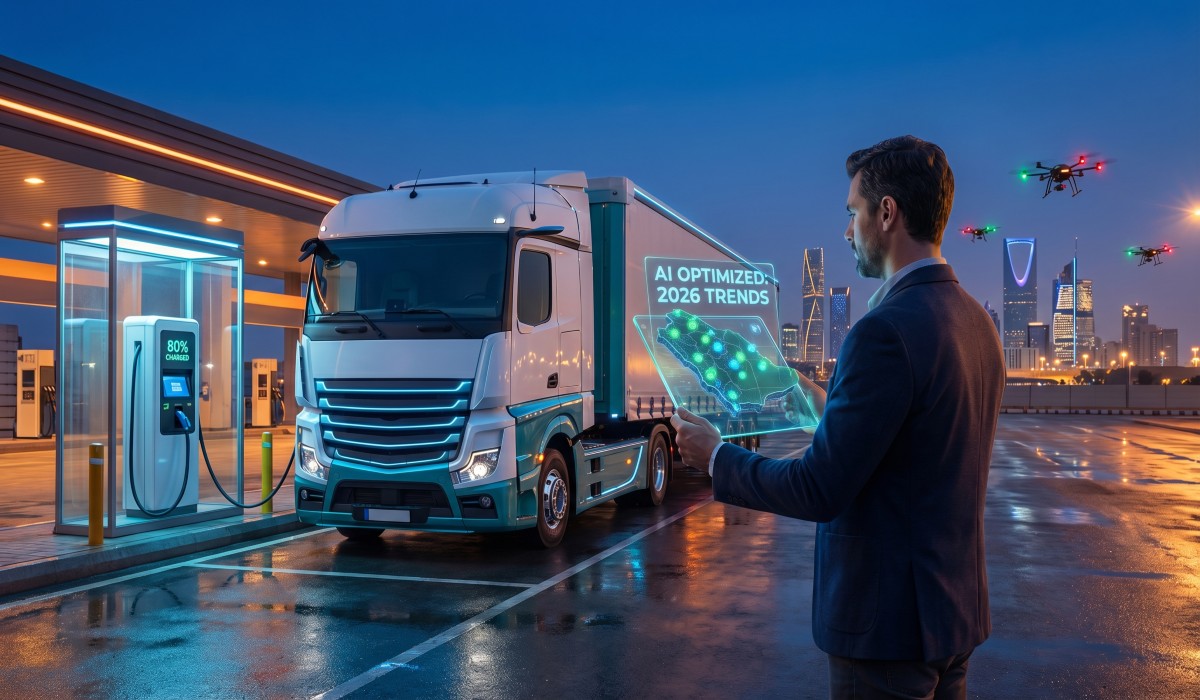
The fleet management industry is moving faster than most businesses in Saudi Arabia are prepared for. Whether you’re running 10 vehicles or 500, the decisions you make about technology and operations in 2026 will determine how competitive you stay over the next decade (FleetRabbit, n.d., #). AI fleet management tools that seemed experimental two years ago are now standard practice (Placematic, n.d., #). Electric vehicles are appearing in corporate fleets across Riyadh and Jeddah (ZigWheels KSA). And the companies that haven’t started thinking about fleet sustainability 2026 goals are already behind their competitors (Vision 2030).
This blog cuts through the noise and focuses on what actually matters for fleet operators and logistics managers in the Kingdom right now.
AI Is No Longer Optional in Fleet Operations
Let’s be direct: if your fleet management strategy doesn’t include artificial intelligence in some form, you’re paying more than you need to and reacting to problems instead of preventing them (Palm Horizon, n.d., #).
AI fleet management tools now handle everything from route optimization to driver behavior scoring (FleetRabbit, n.d., #). In the Saudi context, where long inter-city routes between Riyadh, Dammam, and Jeddah are standard, these tools analyze real-time traffic, road conditions, and delivery windows to pick the fastest path automatically, without dispatcher guesswork (Placematic, n.d., #).
The real business value shows up in the data. Fleets using AI-driven dispatch report fuel savings of 12–18% within the first six months (HotBot). Driver incidents drop because the system flags risky patterns like sharp braking or extended idling before they become accidents or HR problems (Reuters). For companies managing deliveries under Vision 2030’s expanding logistics corridors, that kind of efficiency isn’t just convenient, it’s a competitive necessity (Vision 2030).
Predictive Maintenance Is Saving Fleets Millions
Breakdowns cost money. But unplanned breakdowns cost more: lost contracts, delayed shipments, emergency repair markups, and drivers sitting idle on the shoulder of King Fahd Road (AgileSoft Labs). Predictive maintenance fleet technology changes that equation completely.
Using sensors connected through IoT fleet management systems, vehicles now report their own health in real time (AVL KSA, n.d., #). Engine temperature spikes, brake wear indicators, and transmission stress signals the system sees them before the driver does. Maintenance teams get scheduled alerts weeks in advance, not emergency calls on Sunday mornings.
For Saudi fleet operators, this matters especially because of the climate conditions. Extreme summer heat accelerates engine wear and battery performance issues at a rate most maintenance schedules don’t account for (ZigWheels KSA). IoT-connected vehicles track temperature-related stress on components and adjust maintenance triggers accordingly. One logistics company in Dammam reduced its unplanned breakdown rate by 34% in the first year after implementing IoT fleet management across its heavy vehicle fleet (AVL KSA, n.d., #). That’s not a small number.
EV Fleets Are Arriving. Are You Ready?
Electric vehicle fleet adoption is no longer a future conversation (YoCharge, n.d., #). Saudi Aramco logistics partners, government procurement programs, and major private sector transport companies have already started transitioning portions of their fleets to EVs (ZigWheels KSA). The government’s push toward reducing carbon emissions aligns directly with Vision 2030’s environmental goals, and businesses that get ahead of this shift will avoid being pressured into rapid, expensive transitions later (EV Infrastructure News).
The practical challenges are real. Charging infrastructure in Saudi Arabia is still developing, and range anxiety on long-haul routes is a legitimate operational concern (ZigWheels KSA). But for urban delivery fleets—food delivery, last-mile logistics, pharmaceutical distribution—the numbers already work. Lower fuel costs, reduced maintenance (EVs have fewer moving parts), and government incentives on commercial EV adoption make the business case straightforward (YoCharge, n.d., #).
Fleet sustainability 2026 planning should include an honest audit of which vehicle categories in your fleet are candidates for electrification now versus in two to three years. Urban routes under 200km per day: ready now. Long-haul inter-city: wait for infrastructure(YoCharge, n.d., #).
Cloud Fleet Management: Ditch the On-Site Server Mentality
Cloud fleet management solutions have replaced legacy on-premise systems as the standard for any fleet above 20 vehicles (Zawya, n.d., #). The reason is simple: your operations don’t stop at 5pm, and neither should your visibility.
Cloud-based platforms give fleet managers access to live dashboards from any device (Zawya, n.d., #). Supervisors in Riyadh can monitor vehicles operating in the Eastern Province without being tethered to a specific workstation. Dispatchers using a fleet tracking app get instant alerts on vehicle status, route deviations, and unauthorized stops, the kind of real-time control that was only possible with dedicated IT infrastructure just five years ago (Zawya, n.d., #).
The scalability argument is also straightforward. Adding 20 vehicles to a cloud system takes hours, not weeks of hardware procurement and configuration. For growing businesses in Saudi Arabia’s expanding logistics market, speed matters (Zawya, n.d., #).
5G Is Changing What’s Possible on the Road
5G fleet technology is the infrastructure layer underneath many of the other trends on this list. Without fast, low-latency connectivity, real-time AI decision-making, live video feeds from vehicle dashboards, and instant IoT sensor data transmission simply don’t work well enough to be reliable (Vision 2030).
Saudi Arabia’s 5G rollout has been aggressive. STC, Mobily, and Zain have expanded coverage significantly across major cities and key highway corridors (Vision 2030). For fleet operators, this means the connected vehicle features that previously suffered from lag or dropped signals are now genuinely dependable in most operating zones (Vision 2030).
Big Data Analytics: From Spreadsheets to Strategy
The average mid-size fleet generates more data in a week than any human team can meaningfully review manually (IFPRI). Big data fleet analytics tools are built specifically to turn that volume into decisions.
Fleet managers who use analytics platforms don’t just know that costs went up—they know exactly which routes, which vehicle types, and which driver behaviors drove the increase (IFPRI). They can run scenario models. What happens to fuel spend if we reroute the Riyadh–Makkah run through Highway 40 instead of Highway 15? What’s the total cost difference if we shift vehicle replacement from year 5 to year 4 across the fleet?
When combined with fleet vehicle dispatch systems, big data analytics closes the loop between planning and execution (IFPRI). Dispatch decisions informed by historical performance data result in better load optimization, fewer empty return trips, and measurable improvements in cost per kilometer.
Autonomous Vehicle Tracking: Not Science Fiction Anymore
Full autonomous driving is still years away from widespread commercial adoption in Saudi Arabia (CNN). But autonomous vehicle tracking—meaning systems that monitor, guide, and assist drivers without replacing them—is already deployed across advanced logistics operations in the region.
Lane departure warnings, automatic speed limit compliance, geofenced zone alerts, and driver fatigue detection all fall under this category (CNN). These systems reduce the cognitive load on drivers during long shifts and catch the kind of gradual human errors that lead to accidents on quiet stretches of highway at 2am.
For fleet managers, the insurance implications alone are worth paying attention to. Several regional insurers now offer premium discounts for fleets equipped with certified driver assistance systems (Insurance Business Arabia). The math often works in favor of the technology investment within 18 months.
What This Means for Your Fleet in 2026
The businesses that pull ahead in Saudi Arabia’s logistics and transport sector this year won’t necessarily be the ones with the most vehicles or the biggest budgets. They’ll be the ones who build their operations on connected, data-driven infrastructure (Placematic, n.d., #).
IoT fleet management reduces costs and prevents breakdowns. Cloud fleet management solutions give you visibility and control at scale. 5G fleet technology makes real-time decision-making reliable. Predictive maintenance fleet systems protect your assets before problems develop. And electric vehicle fleet adoption positions your business ahead of the regulatory and sustainability expectations that are coming regardless (YoCharge, n.d., #).
The fleet management trends 2026 landscape points in one clear direction: smarter operations, better data, and proactive rather than reactive management. Saudi businesses that act on these shifts now will be competing from a position of strength. Those who wait will spend the next few years catching up.
Start by evaluating where your current fleet technology sits against these trends. The gap between where you are and where the industry is heading is the starting point for every smart investment decision you’ll make this year (FleetRabbit, n.d., #).
References
CNN. (n.d.). https://edition.cnn.com/2025/12/05/tech/autonomous-vehicles-saudi-arabia/index.html
EV Infrastructure News. (n.d.). https://evinfrastructurenews.com/emobility/vision-2030-eviq-nhc-saudi-arabia
FleetRabbit. (n.d.). https://fleetrabbit.com/article/fleet-management-trends-2026
HotBot. (n.d.). https://hotbot.com/articles/how-smart-tech-is-transforming-cargo-transport-and-fleet-management-in-2026
IFPRI. (n.d.). https://www.ifpri.org/blog/big-data-and-smart-logistics
Insurance Business Arabia. (n.d.). https://www.insurancebusinessmag.com/mena/news/technology/saudi-insurers-incentivize-driver-safety-systems-2025-01-23.aspx
Palm Horizon. (n.d.). https://palmhorizonksa.com/ai-in-logistics/
Placematic. (n.d.). https://placematic.com/logistics-and-fleet-management-trends-for-2026
Reuters. (n.d.). https://www.reuters.com/technology/can-ai-realise-its-potential-to-pave-the-way-for-greener-logistics-2025-06-02/
Vision 2030. (n.d.). https://vision2030.gov.sa/en/sectors/technology
YoCharge. (n.d.). https://yocharge.com/blog/fleet-electrification-in-saudi-arabia-how-vision-2030-is-driving-the-transition
Zawya. (n.d.). https://www.zawya.com/en/press-release/companies-news/zain-ksa-unveils-100-saudi-made-fleet-management-system-xr6jaxgg
ZigWheels KSA. (n.d.). https://zigwheelsksa.com/car-news/fleet-electrification-in-saudi-arabia-are-companies-ready.zawya.com/en/press-release/companies-news/zain-ksa-unveils-100-saudi-made-fleet-management-system-xr6jaxgg
ZigWheels KSA. (n.d.). https://zigwheelsksa.com/car-news/fleet-electrification-in-saudi-arabia-are-companies-ready